Contact voucher specification
Abstract
In order to join or initiate a conversation securely, participants need to exchange cryptographic key material. To address this problem, we created a slightly unusual design: contact vouchers.
Voucher design
In many systems, an invitation to communicate flows from an existing member of a conversation to the user being invited. In our contact voucher protocol, this flow is reversed: Bob, who wishes to join a conversation, hands a contact voucher (out-of-band) to existing member Alice, who then inducts Bob into the group.
This design mitigates two potential problems with the conventional way of doing things:
-
A third party who observes the contact voucher does not get to read either participant’s actual messages. However,
-
A passive adversary learns that the voucher was spent, but does not get to observe further interactions.
-
An active adversary can create a new fake group to induct the member into, but does not learn anything about the existing group.
In the future, to prevent this one-way impersonation, we could require that Alice and Bob both bring something on paper to their meeting.
-
Bob brings the contact voucher.
-
Alice brings a fingerprint for the
VoucherReplyPublicKey(thwarting the active attacker).
-
-
Only one thing that needs to delivered out-of-band to achieve a two-pass protocol (instead of a three-pass protocol):
- One of the parties needs to bring key material to a meeting in order to establish contact.
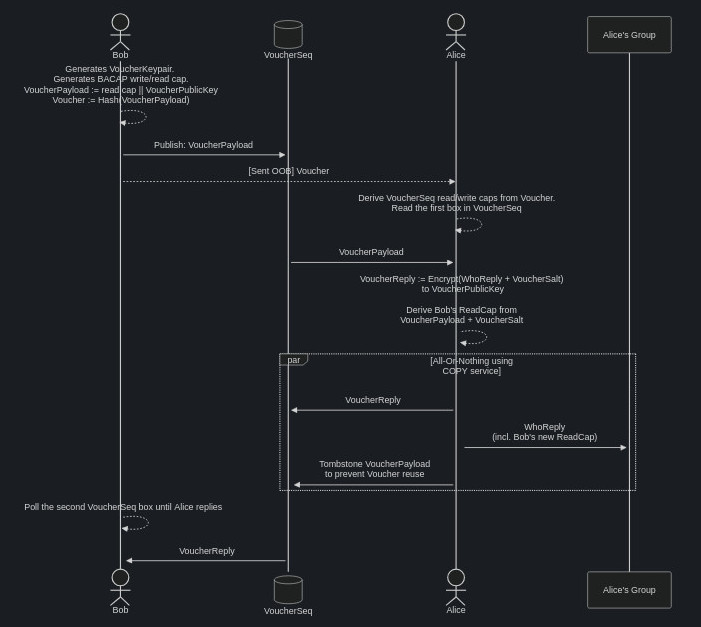
The following diagram illustrates the contact voucher authentication handshake.
Figure 1. Contact voucher handshake
Self-authenticating BACAP payload
The first message sent, the VoucherPayload, is authenticated in the following
manner:
-
The
VoucherPayloadis computed. -
A cryptographic hash of the
VoucherPayloadis computed. This hash is the Voucher. -
The Voucher is used to derive a BACAP read/write capability set.
-
The
VoucherPayloadis uploaded to the BACAP sequence described by the capability (at index 0). -
Anyone who intercepts the Voucher can read and write the sequence.
-
But: Since the Voucher is a hash over the
VoucherPayload, writing the sequence with anything but theVoucherPayloadwill be detectable by the recipient. -
This means that the contents cannot be modified undetectably by the interceptor.