12 - References
AB96
Anderson, R., Biham, E., βTwo Practical and Provably Secure Block Ciphers: BEAR and LIONβ, 1996.
AEZV5
Hoang, V., Krovetz, T., Rogaway, P., βAEZ v5: Authenticated Encryption by Encipheringβ, March 2017,
http://web.cs.ucdavis.edu/~rogaway/aez/aez.pdf.
BRIDGING
Danezis, G., Syverson, P., βBridging and Fingerprinting: Epistemic Attacks
on Route Selectionβ, Proceedings of PETS 2008, Leuven, Belgium,
July 2008, https://www.freehaven.net/anonbib/cache/danezis-pet2008.pdf.
COMPULS05
Danezis, G., Clulow, J., βCompulsion Resistant Anonymous Communicationsβ,
Proceedings of Information Hiding Workshop, June 2005,
https://www.freehaven.net/anonbib/cache/ih05-danezisclulow.pdf.
ED25519
https://www.rfc-editor.org/rfc/rfc8032.
FINGERPRINTING
Danezis, G., Clayton, R., βRoute Finger printing in Anonymous
Communicationsβ,
https://www.cl.cam.ac.uk/~rnc1/anonroute.pdf.
KATZMIXNET
Angel, Y., Danezis, G., Diaz, C., Piotrowska, A., Stainton, D., βKatzenpost
Mix Network Specificationβ, June 2017,
https://katzenpost.network/docs/specs/pdf/mixnet.pdf.
KATZMIXPKI
Angel, Y., Piotrowska, A., Stainton, D., βKatzenpost Mix Network Public Key Infrastructure Specificationβ, December 2017, https://katzenpost.network/docs/specs/pdf/pki.pdf.
KATZMIXWIRE
Angel, Y., βKatzenpost Mix Network Wire Protocol Specificationβ, June 2017,
https://katzenpost.network/docs/specs/pdf/wire.pdf.
KEMCOMB
Federico Giacon, Felix Heuer, Bertram Poettering, βKEM Combinersβ, 2018,
https://link.springer.com/chapter/10.1007/978-3-319-76578-5_7
LOCALVIEW
Gogolewski, M., Klonowski, M., Kutylowsky, M., βLocal View Attack on
Anonymous Communicationβ,
https://cs.pwr.edu.pl/kutylowski/articles/LocalView-WWW.pdf.
LOOPIX
Piotrowska, A., Hayes, J., Elahi, T., Meiser, S., Danezis, G., βThe Loopix Anonymity SystemβUSENIX, August 2017,
https://arxiv.org/pdf/1703.00536.pdf.
MIRANDA
Leibowitz, H., Piotrowska, A., Danezis, G., Herzberg, A., βNo right
to remain silent: Isolating Malicious Mixesβ, 2017,
https://eprint.iacr.org/2017/1000.pdf.
MIXMINION
Danezis, G., Dingledine, R., Mathewson, N., βMixminion: Design of a
Type III Anonymous Remailer Protocolβ,
https://www.mixminion.net/minion-design.pdf.
MIXMINIONDIRAUTH
Danezis, G., Dingledine, R., Mathewson, N., βType III (Mixminion) Mix
Directory Specificationβ, December 2005,
https://www.mixminion.net/dir-spec.txt.
MIXRELIABLE
Dingledine, R., Freedman, M., Hopwood, D., Molnar, D., βA Reputation
System to Increase MIX-Net Reliabilityβ, 2001, Information Hiding, 4th
International Workshop,
https://www.freehaven.net/anonbib/cache/mix-acc.pdf.
MIXTOPO10
Diaz, C., Murdoch, S., Troncoso, C., βImpact of Network Topology on
Anonymity and Overhead in Low-Latency Anonymity Networksβ, PETS, July
2010, https://www.esat.kuleuven.be/cosic/publications/article-1230.pdf.
MPRA11
Maines, L., Piva, M., Rimoldi, A., Sala, M., βOn the provable security of BEAR and LION schemesβ, May 2011, arXiv:1105.0259,
https://arxiv.org/abs/1105.0259.
NOISE
Perrin, T., βThe Noise Protocol Frameworkβ, May 2017,
https://noiseprotocol.org/noise.pdf.
NOISEHFS
Weatherley, R., βNoise Extension: Hybrid Forward Secrecyβ,
https://github.com/noiseprotocol/noise_hfs_spec/blob/master/output/noise_hfs.pdf.
PEERFLOW
Johnson, A., Jansen, R., Segal, A., Syverson, P., βPeerFlow: Secure Load
Balancing in Torβ, July 2017, Proceedings on Privacy Enhancing Technologies,
https://petsymposium.org/2017/papers/issue2/paper12-2017-2-source.pdf.
PQNOISE
Yawning Angel, Benjamin Dowling, Andreas HΓΌlsing, Peter Schwabe and Florian Weber,
βPost Quantum Noiseβ, September 2023,
https://eprint.iacr.org/2022/539.pdf.
RFC2119
Bradner, S., βKey words for use in RFCs to Indicate Requirement
Levelsβ, BCP 14, RFC 2119, DOI 10.17487/RFC2119, March 1997, http://www.rfc-editor.org/info/rfc2119.
RFC5246
Dierks, T. and E. Rescorla, βThe Transport Layer Security (TLS) Protocol
Version 1.2β, RFC 5246, DOI 10.17487/RFC5246, August 2008, http://www.rfc-editor.org/info/rfc5246.
RFC5322
Resnick, P., Ed., βInternet Message Formatβ, RFC 5322, DOI 10.17487/RFC5322, October 2008, https://www.rfc-editor.org/info/rfc5322.
RFC6234
Eastlake 3rd, D. and T. Hansen, βUS Secure Hash Algorithms (SHA and SHA-based HMAC and HKDF)β, RFC 6234, DOI 10.17487/RFC6234, May 2011,
https://www.rfc-editor.org/info/rfc6234.
RFC7049
C. Bormann, P. Hoffman, βConcise Binary Object Representation (CBOR)β, Internet Engineering Task Force (IETF), October 2013,
https://www.rfc-editor.org/info/rfc7049.
RFC7515
Jones, M., Bradley, J., Sakimura, N., βJSON Web Signature (JWS)β, May 2015,
https://www.rfc-editor.org/info/rfc7515.
RFC7539
Nir, Y. and A. Langley, βChaCha20 and Poly1305 for IETF Protocolsβ, May 2015, RFC 7539, DOI 10.17487/RFC7539,
http://www.rfc-editor.org/info/rfc7539.
RFC7693
Saarinen, M-J., Ed., and J-P. Aumasson, βThe BLAKE2 Cryptographic Hash and Message Authentication Code (MAC)β, RFC 7693, DOI 10.17487/RFC7693, November 2015,
http://www.rfc-editor.org/info/rfc7693.
RFC7748
Langley, A., Hamburg, M., and S. Turner, βElliptic Curves for Securityβ, RFC 7748, January 2016,
https://www.rfc-editor.org/info/rfc7748.
SECNOTSEP
Miller, M., Tulloh, B., Shapiro, J., βThe Structure of Authority: Why
Security Is not a Separable Concerβ,
http://www.erights.org/talks/no-sep/secnotsep.pdf.
SEDA
Welsh, M., Culler, D., Brewer, E., βSEDA: An Architecture
for Well-Conditioned, Scalable Internet Servicesβ, 2001, ACM
Symposium on Operating Systems Principles,
http://www.sosp.org/2001/papers/welsh.pdf.
SFMIX03
Danezis, G., βForward Secure Mixesβ, Proceedings of 7th Nordic
Workshop on Secure IT Systems, 2002, https://www.freehaven.net/anonbib/cache/Dan:SFMix03.pdf.
SP80038A
Dworkin, M., βRecommendation for Block Cipher Modes of Operationβ, SP800-38A, 10.6028/NIST.SP.800, December 2001,
https://doi.org/10.6028/NIST.SP.800-38A.
SPHINCS256
Bernstein, D., Hopwood, D., Hulsing, A., Lange, T., Niederhagen, R., Papachristodoulou,
L., Schwabe, P., Wilcox O’Hearn, Z.,
βSPHINCS: practical stateless hash-based signaturesβ,
http://sphincs.cr.yp.to/sphincs-20141001.pdf.
SPHINX09
Danezis, G., Goldberg, I., βSphinx: A Compact and Provably Secure Mix
Formatβ, DOI 10.1109/SP.2009.15, May 2009, https://cypherpunks.ca/~iang/pubs/Sphinx_Oakland09.pdf.
SPHINXSPEC
Angel, Y., Danezis, G., Diaz, C., Piotrowska, A., Stainton, D., βSphinx Mix Network Cryptographic Packet Format Specificationβ, July 2017,
https://katzenpost.network/docs/specs/pdf/sphinx.pdf.
TORDIRAUTH
βTor directory protocol, version 3β,
https://spec.torproject.org/dir-spec/index.html.
TORSRV
βTor Shared Random Subsystem Specificationβ,
https://spec.torproject.org/srv-spec/index.html.
XWING
Manuel Barbosa, Deirdre Connolly, JoΓ£o Diogo Duarte, Aaron Kaiser, Peter Schwabe,
Karoline Varner, Bas Westerbaan, βX-Wing: The Hybrid KEM Youβve Been Looking
Forβ,
https://eprint.iacr.org/2024/039.pdf.
15 -
Pigeonhole Protocol Design Specification
Abstract
In this specification we describe the components and protocols that
compose Pigeonhole scattered storage. We define the behavior of
communication clients that send and retrieve individual messages,
BACAP streams, and AllOrNothing streams. Client actions are mediated
through courier services that interact with storage replicas.
Introduction
Pigeonhole scattered storage enables persistent anonymous
communication in which participants experience a coherent sequence of
messages or a continuous data stream, but where user relationships and
relations between data blocks remain unlinkable not only from the
perspective of third-party observers, but also from that of the mixnet
components. This latter attribute provides resilience against
deanonymization by compromised mixnet nodes.
The data blocks that Pigeonhole stores are supplied by the BACAP
(Blinding-and-Capability) scheme. The Pigeonhole protocol scatters
messages around the many storage servers and among a space of BACAP Box IDs.
From a passive network observer’s perspective all of this is seemingly random.
All communication among users consists of
user-generated read or write queries to Pigeonhole storage, never
directly to other users.
Many protocols are possible to compose using Pigeonhole communication channels,
including group communications. This specification
describes the protocols that are also detailed in our paper, in section entitled
“5.6. End-to-end reliable group channels”. For more
information about BACAP, see “Echomix: a Strong Anonymity System with
Messaging”, chapter 4: https://arxiv.org/abs/2501.02933. For an
understanding of how the core BACAP primitives are implemented,see
https://github.com/katzenpost/hpqc/blob/main/bacap/bacap.go.
Message-layout snippets in this specification are given in the
trunnel binary-format description language (matching
pigeonhole/pigeonhole_messages.trunnel); code snippets showing
in-memory courier or replica state are given in Go.
Glossary
-
Box: BACAP’s unit of data storage. Each box has a box ID (which also serves as its public key), a signature, and a ciphertext signed payload.
-
Courier: Service that runs on a service node and interacts with
storage replicas. Proxies requests from clients and routes replies
back to clients (via SURBs).
-
Storage replica: The actual storage nodes where message ciphertexts
are stored and retrieved.
-
Intermediate replica: See “5.4.1. Writing messages”:
Intermediate replicas are chosen independently of the two final
replicas for that box ID, which they are derived using the sharding
scheme. The reason Alice designates intermediate replicas, as
opposed to addressing the final replicas directly, is to avoid
revealing to the courier which shard the box falls into.
-
Designated replica (a.k.a. final replica, shard replica):
One of the two replicas selected deterministically for a given Box
ID by the Shard2 consistent-hash algorithm. The intermediate
replicas replicate writes through to the designated replicas.
-
EnvelopeHash: BLAKE2b-256(CourierEnvelope.sender_pubkey || CourierEnvelope.ciphertext). Used by the courier for deduplication
of retransmissions and for demultiplexing replica replies.
-
MKEM: Multi-recipient KEM addressed to the pair of intermediate
replicas. One MKEM ciphertext carries, for each recipient, a
separate DEK encapsulation (Dek1, Dek2); either recipient may
decapsulate and recover the padded ReplicaInnerMessage.
-
Replica-epoch: A one-week period, distinct from the 20-minute
mixnet PKI epoch, during which a given replica-side MKEM envelope
keypair is valid. See “Epochs” below.
Deployment requirements
Minimum number of storage replicas
A conforming deployment MUST run at least four storage replicas
(n β₯ 4). The reason is the intermediate-replica unlinkability property
described in the Glossary and in Β§5.4.1 of the paper: for each
CourierEnvelope, the client picks two intermediate replicas which
MUST be disjoint from the two final (sharded) replicas that hold
the Box. Disjointness is what prevents the courier from learning
which shard the Box falls into.
- n = 2: there is only one possible shard set, and the
intermediate set is necessarily identical to it.
- n = 3: only one replica sits outside any given two-shard set,
so the client cannot pick two independent non-shard intermediates.
Implementations in this case fall back to an intermediate set that
includes at least one shard replica, which tells the courier that
replica is one of the two shards for the Box.
- n β₯ 4: at least two non-shard replicas exist, so the
intermediate set can be drawn uniformly at random from the
non-shard subset, and disjointness is preserved.
When the disjointness invariant is broken (n = 3), the courier
learns that at least one of its two intermediate replicas is in the
Box’s shard set. This exposure is bounded:
- The courier does NOT learn the Box ID. The Box ID lives inside the
MKEM-encrypted inner message addressed to the intermediate
replicas; only the replicas can decrypt it.
- The courier does NOT learn the other shard member. Knowing one
element of the two-element shard set does not constrain the
identity of the other among the remaining replicas.
- The courier does NOT gain a way to link Boxes in the same
sequence. BACAP’s unlinkability of consecutive Box IDs (paper Β§4)
is a property of the capability-derivation scheme and is
independent of sharding.
Consequently, the main unlinkability properties of Pigeonhole are
not lost at n = 3, but the defense-in-depth margin provided by
disjoint intermediate replicas is. Operators SHOULD treat n β₯ 4 as
the minimum supported configuration.
Epochs
Katzenpost has two distinct notions of “epoch” that operate on very
different timescales, and Pigeonhole touches both:
- Mixnet epoch (a.k.a. normal epoch, PKI epoch): the short
cadence on which the directory authorities publish a new PKI
document. The default is 20 minutes. Mix nodes, gateways, service
nodes, and clients all synchronise on this epoch. Mix-node Sphinx
replay keys rotate once per mixnet epoch.
- Pigeonhole storage-replica epoch: the long cadence on which
each storage replica rotates its MKEM envelope keypair. The default
is one week. A replica publishes, in every mixnet-epoch PKI
descriptor, two envelope public keys: the current replica-epoch
key and the next replica-epoch key.
Epoch tolerance for CourierEnvelope
A CourierEnvelope carries an epoch field that identifies the
replica-epoch whose envelope key the client used to encrypt the MKEM
ciphertext. Conforming couriers and storage replicas MUST accept
epoch β {current β 1, current, current + 1} where current is the
courier’s / replica’s own view of the current replica-epoch.
The current β 1 tolerance handles the grace window immediately
after a replica-epoch boundary, when a client with a slightly stale
PKI view still encrypts to the previous envelope public key.
Combined with current, this gives a two replica-epoch data TTL
β roughly two weeks β because the future replica-epoch key is by
definition a key that hasn’t started being used yet, so current
and current β 1 are the epochs where actual data flows.
The current + 1 tolerance handles the same boundary seen from the
other side: a client whose clock or PKI view is slightly ahead of
the courier / replica.
Envelopes outside this three-epoch window MUST be rejected, because
by definition no replica still holds the matching decapsulation key:
- Older than
current β 1: the envelope public key has been pruned
from replicas (see the replica’s envelope-key GC worker). The
replica cannot decrypt and the courier can fail fast rather than
forward a doomed request.
- Newer than
current + 1: no replica has generated that envelope
key yet (replicas generate current and current + 1 only).
Couriers SHOULD reject with a dedicated envelope-level error code
(EnvelopeErrorInvalidEpoch) so clients can distinguish “stale
encryption” from other courier-side rejections.
The Pigeonhole message types are defined in trunnel at
pigeonhole/pigeonhole_messages.trunnel;
the Go bindings live in
pigeonhole/trunnel_messages.go.
All integer fields are big-endian and all variable-length fields carry
an explicit length prefix. This trunnel encoding replaces the earlier
CBOR encoding with a fixed-overhead binary format whose serialised
size can be computed deterministically from the Sphinx geometry.
Carriage of these messages differs by hop:
- Client β Courier: a
CourierQuery (its layout is given in the
“CourierQuery” section) is carried inside
a Sphinx packet payload. The reverse direction uses a SURB supplied
by the client.
- Courier β Replica and Replica β Replica: the courier and
replicas do not use Sphinx packets between themselves. They communicate
over the Katzenpost wire protocol defined in
core/wire and
core/wire/commands; the relevant commands are ReplicaMessage,
ReplicaMessageReply, ReplicaWrite, and ReplicaWriteReply. Some of
these commands embed trunnel-serialised pigeonhole blobs as their
payload.
Fundamental size constants
| Constant |
Value |
Source |
BACAP_BOX_ID_SIZE |
32 bytes |
Ed25519 public key |
BACAP_SIGNATURE_SIZE |
64 bytes |
Ed25519 signature |
HASH_SIZE |
32 bytes |
BLAKE2b-256 |
MKEM_DEK_SIZE |
60 bytes |
mkem.DEKSize |
| CTIDH-1024 public key |
160 bytes |
hpqc/nike/ctidh/ctidh1024 |
| X25519 public key |
32 bytes |
hpqc/nike/x25519 |
| Hybrid CTIDH-1024 Γ X25519 NIKE public key |
192 bytes |
sum of the above |
| BACAP payload encryption overhead |
16 bytes |
ChaCha20-Poly1305 AEAD |
| MKEM encapsulation overhead |
28 bytes |
ChaCha20-Poly1305 nonce (12) + tag (16) |
Maximum BACAP payload
The maximum plaintext BACAP payload a single Box can carry is derived
backwards from the Sphinx UserForwardPayloadLength by subtracting
every layer of framing and cryptographic overhead that sits between the
Sphinx payload and the BACAP plaintext. The authoritative calculation
is performed by NewGeometryFromSphinx in
pigeonhole/geo/geometry.go.
Informally:
MaxPlaintextPayloadLength
= UserForwardPayloadLength
β CourierQuery framing (1 byte: query_type discriminator)
β CourierEnvelope header (intermediate_replicas[2] + Dek1 + Dek2
+ reply_index + epoch + sender_pubkey_len
+ sender_pubkey + ciphertext_len)
β MKEM AEAD overhead (28 bytes)
β ReplicaInnerMessage framing (1 byte: message_type discriminator)
β ReplicaWrite header (box_id + signature + payload_len = 100 bytes)
β BACAP AEAD overhead (16 bytes)
β BACAP length prefix (4 bytes)
With a hybrid CTIDH-1024 Γ X25519 NIKE the fixed per-packet overhead
between UserForwardPayloadLength and the BACAP plaintext is on the
order of 560 bytes; the exact figure depends on the configured NIKE
scheme and should always be obtained from
geometry.NewGeometryFromSphinx() rather than computed by hand.
The CourierEnvelope as seen by the courier
The courier, upon unwrapping the Sphinx payload of a client’s packet,
sees a CourierQuery whose content is a CourierEnvelope with the
following layout:
struct courier_envelope {
u8 intermediate_replicas[2]; // replica indices in the PKI
u8 dek1[MKEM_DEK_SIZE]; // DEK encapsulation for replica 0
u8 dek2[MKEM_DEK_SIZE]; // DEK encapsulation for replica 1
u8 reply_index; // which replica's reply to prefer
u64 epoch; // replica-epoch under which the
// MKEM ciphertext was produced
u16 sender_pubkey_len;
u8 sender_pubkey[sender_pubkey_len]; // client's ephemeral hybrid NIKE pk
u32 ciphertext_len;
u8 ciphertext[ciphertext_len]; // MKEM-encrypted ReplicaInnerMessage
}
Notable points:
- The
ciphertext is opaque to the courier. It is an MKEM envelope
addressed to the pair of intermediate replicas; either replica can
decapsulate using its own DEK (dek1 or dek2 respectively).
- The
epoch field names the replica-epoch whose envelope keys were
used to produce the MKEM ciphertext. See the “Epochs” section above
for the tolerance window.
- Prior to encryption, the inner
ReplicaInnerMessage is zero-padded
to ReplicaInnerMessageWriteSize() so that reads, writes and
tombstones produce MKEM ciphertexts of identical length.
The ReplicaInnerMessage as seen by a replica
Once an intermediate replica decrypts the MKEM envelope, it obtains a
ReplicaInnerMessage β a discriminated union over message_type:
struct replica_inner_message {
u8 message_type IN [0, 1]; // 0 = read, 1 = write
union content[message_type] {
0: struct replica_read read_msg; // { box_id[32] }
1: struct replica_write write_msg; // { box_id[32], signature[64],
// payload_len[u32], payload[] }
};
}
A ReplicaWrite with payload_len == 0 is a tombstone; see
“Tombstones” below.
Message types and interactions
Overview
- A client sends a
CourierQuery inside a Sphinx packet payload.
The courier’s reply travels back to the client by means of a SURB
the client also supplied.
- A client always designates two intermediate replicas per
CourierEnvelope. The courier dispatches the corresponding pair of
ReplicaMessage wire commands, one to each intermediate, and
collects up to two ReplicaMessageReply results.
- The
reply_index field is a preference indicating which of the two
replica replies the client would like forwarded first. It is not a
strict selector: should the preferred slot still be empty when the
courier is ready to respond, the courier falls back to whichever
reply it does hold, and indicates in the CourierEnvelopeReply the
actual index that was served (see
courier/server/plugin.go).
- Clients MUST resend identical
CourierEnvelope bodies β same
sender_pubkey and ciphertext β until they receive a reply. The
courier deduplicates resends by EnvelopeHash. Only the Sphinx-layer
SURB is rotated between retransmissions.
CourierQuery
A CourierQuery is the top-level discriminated union that a client
places into a Sphinx packet payload for the courier:
struct courier_query {
u8 query_type IN [0, 1];
union content[query_type] {
0: struct courier_envelope envelope; // read or write a single box
1: struct copy_command copy_command; // AllOrNothing copy
};
}
The symmetric reply is a CourierQueryReply:
struct courier_query_reply {
u8 reply_type IN [0, 1];
union content[reply_type] {
0: struct courier_envelope_reply envelope_reply;
1: struct copy_command_reply copy_command_reply;
};
}
CourierEnvelope
The CourierEnvelope layout was given in the preceding section. The
client constructs one per read or write. The courier:
- Computes
EnvelopeHash = BLAKE2b-256(sender_pubkey || ciphertext).
- Verifies
epoch β {current β 1, current, current + 1} per the
replica-epoch tolerance window, rejecting with
EnvelopeErrorInvalidEpoch otherwise.
- Looks
EnvelopeHash up in its dedup cache. If present, the courier
returns the cached reply (or an ACK if no reply has yet arrived)
without re-dispatching to replicas.
- On a cache miss, the courier constructs two
ReplicaMessage wire
commands β one bound for intermediate_replicas[0] carrying
dek1, the other for intermediate_replicas[1] carrying dek2
β and forwards them over the wire protocol.
- The courier immediately sends an ACK reply to the client so it may
stop retransmitting.
ReplicaMessage (wire command)
ReplicaMessage is not a trunnel pigeonhole type; it is the
core/wire/commands command sent from a courier to a replica. Its
payload fields are copied verbatim from the matching CourierEnvelope:
// core/wire/commands
type ReplicaMessage struct {
SenderEPubKey []byte // copied from CourierEnvelope.sender_pubkey
DEK *[MKEM_DEK_SIZE]byte // dek1 or dek2, depending on destination
Ciphertext []byte // copied from CourierEnvelope.ciphertext
}
The recipient replica decapsulates the MKEM envelope using the
replica-epoch key that corresponds to CourierEnvelope.epoch (trying
each of the three keys in its tolerance window), yielding a padded
ReplicaInnerMessage. The replica then dispatches on message_type
to ReplicaRead or ReplicaWrite handling.
ReplicaMessageReply (wire command)
In response to a ReplicaMessage, the courier expects an asynchronous
ReplicaMessageReply wire command from the replica:
// core/wire/commands
type ReplicaMessageReply struct {
ErrorCode uint8 // see the replica error-code table below
EnvelopeHash *[HASH_SIZE]byte // lets the courier demultiplex the reply
EnvelopeReply []byte // MKEM-encrypted ReplicaMessageReplyInnerMessage
}
The EnvelopeReply byte blob is produced by the replica via the MKEM
scheme’s EnvelopeReply() method (see
replica/handlers.go).
It carries a ReplicaMessageReplyInnerMessage β a discriminated union
over either a ReplicaReadReply or a ReplicaWriteReply β padded to
ReplicaReplyInnerMessageReadSize() so that read replies and write
replies are indistinguishable in size, and encrypted to the client’s
ephemeral NIKE public key under the replica’s envelope keypair.
CourierBookKeeping
For each outstanding EnvelopeHash, the courier maintains an in-memory
dedup entry. Its actual structure is:
// courier/server/plugin.go
type CourierBookKeeping struct {
Epoch uint64 // replica-epoch at cache insertion
CreatedAt time.Time // for TTL eviction (~5 minutes)
QueryType uint8 // the query_type that produced this entry
IntermediateReplicas [2]uint8
EnvelopeReplies [2]*commands.ReplicaMessageReply
}
Note that the courier does not cache SURBs or SURB timestamps. A
client’s SURB is consumed by the Sphinx-layer plugin infrastructure at
the moment the courier emits a reply and is not retained by the
courier’s Pigeonhole state. Should the client not receive that reply,
it is expected to retransmit a fresh Sphinx packet carrying a fresh
SURB but the identical CourierEnvelope body; the courier, recognising
the EnvelopeHash, replies using the new SURB.
The dedup cache has a TTL of 5 minutes
(DedupCacheTTL in courier/server/plugin.go).
CourierEnvelopeReply
The courier’s reply to a CourierEnvelope has the following trunnel
layout:
struct courier_envelope_reply {
u8 envelope_hash[HASH_SIZE]; // identifies the originating envelope
u8 reply_index; // which intermediate replica's reply
// is being returned (may differ
// from the client's requested index)
u8 reply_type IN [0, 1]; // 0 = ACK, 1 = PAYLOAD
u32 payload_len;
u8 payload[payload_len]; // the MKEM-encrypted EnvelopeReply,
// present iff reply_type == PAYLOAD
u8 error_code; // see envelope error codes below
}
A reply_type of ACK (0) indicates the courier has received the
envelope and dispatched it to the replicas but has not yet received a
reply for the requested index. A reply_type of PAYLOAD (1)
indicates the payload field carries the MKEM-encrypted
EnvelopeReply produced by a replica.
Embedded pigeonhole types
These trunnel structs are not carried on the wire in isolation; they
are embedded inside MKEM envelopes and their replies.
ReplicaRead
Embedded inside the MKEM-encrypted ReplicaInnerMessage a client
sends to a replica (via the courier) for a read operation.
struct replica_read {
u8 box_id[BACAP_BOX_ID_SIZE];
}
ReplicaReadReply
Embedded inside the MKEM-encrypted ReplicaMessageReplyInnerMessage a
replica returns for a successful read. Padding is applied at the outer
ReplicaMessageReplyInnerMessage level; this struct carries no
padding of its own.
struct replica_read_reply {
u8 error_code;
u8 box_id[BACAP_BOX_ID_SIZE];
u8 signature[BACAP_SIGNATURE_SIZE];
u32 payload_len;
u8 payload[payload_len];
}
ReplicaWrite
Used both (a) embedded inside the MKEM-encrypted ReplicaInnerMessage
for a client write, and (b) carried directly as a core/wire/commands
command between replicas during replication.
struct replica_write {
u8 box_id[BACAP_BOX_ID_SIZE];
u8 signature[BACAP_SIGNATURE_SIZE];
u32 payload_len;
u8 payload[payload_len];
}
A ReplicaWrite with payload_len == 0 is a tombstone; see the
“Tombstones” section below.
ReplicaWriteReply
Embedded inside a ReplicaMessageReplyInnerMessage on the client
reply path, and also used as the core/wire/commands reply to
inter-replica replication.
struct replica_write_reply {
u8 error_code;
}
Tombstones
A ReplicaWrite whose payload_len == 0 is a tombstone: it marks
a Box as deleted without revealing that fact to the courier.
- Replicas treat a tombstone write as an ordinary overwrite. An
existing
Box at the same box_id is replaced by the tombstone,
and subsequent reads of that box_id return
ReplicaErrorTombstone (see “Replica error codes”).
ReplicaErrorTombstone is an expected outcome rather than a
failure: it positively confirms that the Box was deleted, as
distinct from ReplicaErrorBoxNotFound.
- Because the inner
ReplicaInnerMessage is zero-padded to
ReplicaInnerMessageWriteSize() before MKEM encryption (see “The
CourierEnvelope as seen by the courier”), a tombstone write produces
an MKEM ciphertext of exactly the same length as a non-empty write
or a read. A passive observer therefore cannot distinguish deletion
from any other operation.
Tombstones are also used by the AllOrNothing copy protocol: after
processing a CopyCommand, the courier overwrites every Box of the
temporary stream with tombstones (see “Pigeonhole AllOrNothing
protocol”).
EnvelopeHash
The EnvelopeHash uniquely identifies a CourierEnvelope for the
purposes of deduplication and reply demultiplexing. It is computed as:
EnvelopeHash = BLAKE2b-256(sender_pubkey || ciphertext)
where sender_pubkey and ciphertext are the corresponding fields of
the CourierEnvelope. The implementation is
CourierEnvelope.EnvelopeHash()
in pigeonhole/helpers.go.
A retransmitted CourierEnvelope carries the identical
sender_pubkey and ciphertext as the original, and therefore hashes
to the same value; only the surrounding Sphinx packet (and its SURB)
changes between attempts.
Error codes
All error codes are defined in
pigeonhole/errors.go.
Replica error codes
Returned by a replica in ReplicaMessageReply.ErrorCode,
ReplicaReadReply.error_code, and ReplicaWriteReply.error_code.
| Code |
Name |
Meaning |
| 0 |
ReplicaSuccess |
Operation completed successfully |
| 1 |
ReplicaErrorBoxIDNotFound |
Read miss (expected outcome) |
| 2 |
ReplicaErrorInvalidBoxID |
Malformed box ID |
| 3 |
ReplicaErrorInvalidSignature |
BACAP signature verification failed |
| 4 |
ReplicaErrorDatabaseFailure |
Transient RocksDB error |
| 5 |
ReplicaErrorInvalidPayload |
Malformed payload |
| 6 |
ReplicaErrorStorageFull |
Storage capacity exceeded |
| 7 |
ReplicaErrorInternalError |
Internal server error |
| 8 |
ReplicaErrorInvalidEpoch |
Replica-epoch envelope key unavailable |
| 9 |
ReplicaErrorReplicationFailed |
Replication to shard peer failed |
| 10 |
ReplicaErrorBoxAlreadyExists |
Idempotent-write outcome (expected) |
| 11 |
ReplicaErrorTombstone |
Read returned a tombstone (expected) |
Codes 1, 10 and 11 are “expected outcomes” β they correspond to
normal protocol states rather than faults. The thin-client helper
thin.IsExpectedOutcome(err) treats these three codes as non-errors.
Courier envelope error codes
Returned by the courier in CourierEnvelopeReply.error_code.
| Code |
Name |
Meaning |
| 0 |
EnvelopeErrorSuccess |
Operation completed |
| 1 |
EnvelopeErrorInvalidEnvelope |
Malformed envelope (e.g. reply_index > 1) |
| 2 |
EnvelopeErrorCacheCorruption |
Internal cache inconsistency |
| 3 |
EnvelopeErrorPropagationError |
Failed to dispatch to replicas |
| 4 |
EnvelopeErrorInvalidEpoch |
CourierEnvelope.epoch outside tolerance window |
Copy command status codes
Returned by the courier in the status field of a CopyCommandReply
(its layout is given in the “CopyCommandReply” section).
| Code |
Name |
Meaning |
| 0 |
CopyStatusSucceeded |
All destination writes completed |
| 1 |
CopyStatusInProgress |
Courier has accepted the command; processing continues |
| 2 |
CopyStatusFailed |
Aborted; see error_code + failed_envelope_index |
Sharding and replica selection
For each Box, two designated (final) replicas are derived
deterministically from the Box ID using the Shard2 consistent-hash
algorithm (see
replica/common/shard.go):
for each online replica r with identity key k_r:
h_r = BLAKE2b-256(k_r || box_id)
return the two replicas whose h_r are smallest
The two intermediate replicas chosen by the client for a given
CourierEnvelope are drawn independently of the designated replicas,
per pigeonhole.GetRandomIntermediateReplicas:
- n β₯ 4 replicas: two intermediates are drawn uniformly at random
from the replicas that are not in the designated (shard) set β
preserving the disjointness invariant described in “Deployment
requirements” above.
- n = 3: fallback β at least one intermediate must coincide with
a designated replica; this weakens the intermediate/final
disjointness guarantee but does not compromise Box unlinkability.
- n < 3: rejected.
Intermediate replicas, upon accepting a ReplicaWrite, compute the
designated replicas themselves and forward the ReplicaWrite to them
via the core/wire/commands ReplicaWrite command (see
replica/connector.go).
Fixed-throughput connections and decoy traffic
Per Β§5.3 of the Echomix paper, the courier-to-replica and
replica-to-replica wires are fixed-throughput Poisson streams paced
at LambdaR, the per-connection rate parameter published in the
dirauth Parameters block. An external network observer who can see
only encrypted wire timing must not be able to infer load from the
wire; the wire fires at the same constant rate whether or not real
user traffic is flowing, with the gaps filled by indistinguishable
decoy traffic.
The implementation realises this in two pieces, one on each end of a
connection.
Originator-side pacing with decoy fill
Each courier holds one outgoing connection per replica; each
replica holds one outgoing connection per peer replica. Each such
connection has a sender goroutine driven by an exponential
distribution at rate LambdaR. On every tick:
- if the connection’s outbound queue holds a real command (a
ReplicaMessage from the courier-side, or a ReplicaWrite
replication command from the replica-side), the sender drains one
and forwards it;
- otherwise, the sender constructs a fresh
ReplicaDecoy and
forwards that.
The wire’s outbound rate is therefore Poisson at rate LambdaR at
all times, irrespective of how much real traffic the originator
happens to be carrying. Real and decoy commands are uniformly padded
and encrypted under the PQ Noise transport, so an observer cannot
distinguish them by size or content.
The relevant code is courier/server/sender.go’s
sender.worker
and the analogous outgoingSender.worker in
replica/sender.go.
Responder-side delay scheduler
The receiving end of each connection does not use a separately
paced sender. Each inbound command produces exactly one reply (a
real ReplicaWriteReply or ReplicaMessageReply for envelopes,
echoed ReplicaDecoy for decoys). The reply rate therefore equals
the inbound rate by construction, which is LambdaR Poisson.
Replies are NOT drained at a fixed rate. Instead, each reply is
held for an independently sampled uniform random delay, drawn from
Uniform[0, replyJitterMax], and inserted into a per-connection
min-heap keyed on its ready-at timestamp. A worker goroutine pops
the next-due reply and forwards it to the wire.
The per-reply random delay follows Β§5.4 of the paper:
Each reply is independently delayed, with delays sampled from a
uniform distribution to mitigate the courier’s ability to infer
links between responses that pertain to the same box.
The relevant type is delayedReplyEmitter in
replica/sender.go.
Choice of replyJitterMax
Any strictly positive value satisfies the Β§5.4 independence
requirement. The reference implementation uses 50 ms, chosen to
exceed typical per-message processing-time variance on a healthy
replica while remaining small relative to the user-perceptible
round-trip latency. There is no hard constraint that the value be
identical across replicas in the same network. See “Wire-level
indistinguishability” below.
Wire-level indistinguishability
A Poisson stream composed with independent random shifts, of any
distribution, remains a Poisson stream at the same rate. This is the
property that protects the courier-replica and replica-replica
wires from a passive observer, as follows.
- The reply rate from a replica equals the inbound command rate,
which is
LambdaR Poisson.
- Each reply is shifted by an independent random delay (from
Uniform[0, replyJitterMax] on the responder side, or an
exponential interval on the originator side).
- The composition is still Poisson at rate
LambdaR.
A passive observer who can see only encrypted wire timing therefore
sees an indistinguishable Poisson stream regardless of the
underlying shift distribution. Pairing a specific outbound event to
a specific inbound event by timing alone is not possible: the
shifts can arbitrarily reorder events relative to each other, so
many distinct inbound predecessors are equally plausible for any
given outbound.
Bounded responder queue depth
The per-item delay scheduler avoids the M/M/1 boundary case that
arose in earlier designs which paced the responder side at the same
rate as its peer’s command stream. By Little’s Law, the steady-state
heap depth on each inbound connection is the product of the arrival
rate and the mean reply delay:
expected depth = LambdaR Γ replyJitterMax / 2
For LambdaR = 5/s (one tick per ~200 ms) and replyJitterMax = 50 ms, the expected per-connection depth is 0.125 entries, well
below any operationally meaningful queue capacity. The heap depth
remains bounded over arbitrary time horizons because, unlike a
fixed-rate drainer, the per-item scheduler has no “consumer
underrun” failure mode in which the queue can accumulate against a
matched producer.
Protocol sequence visualizations
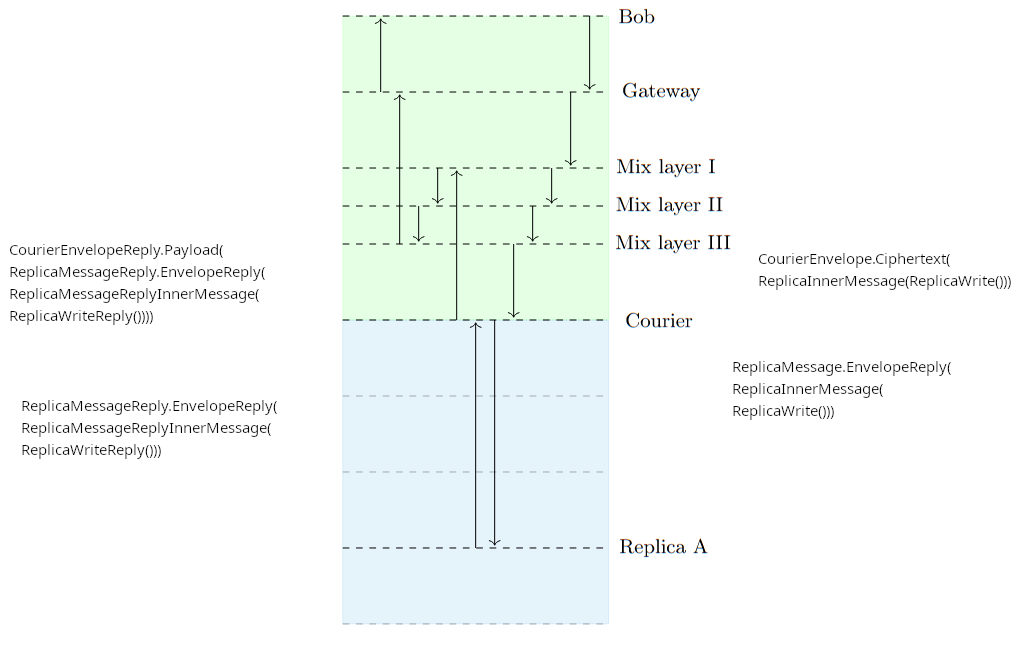
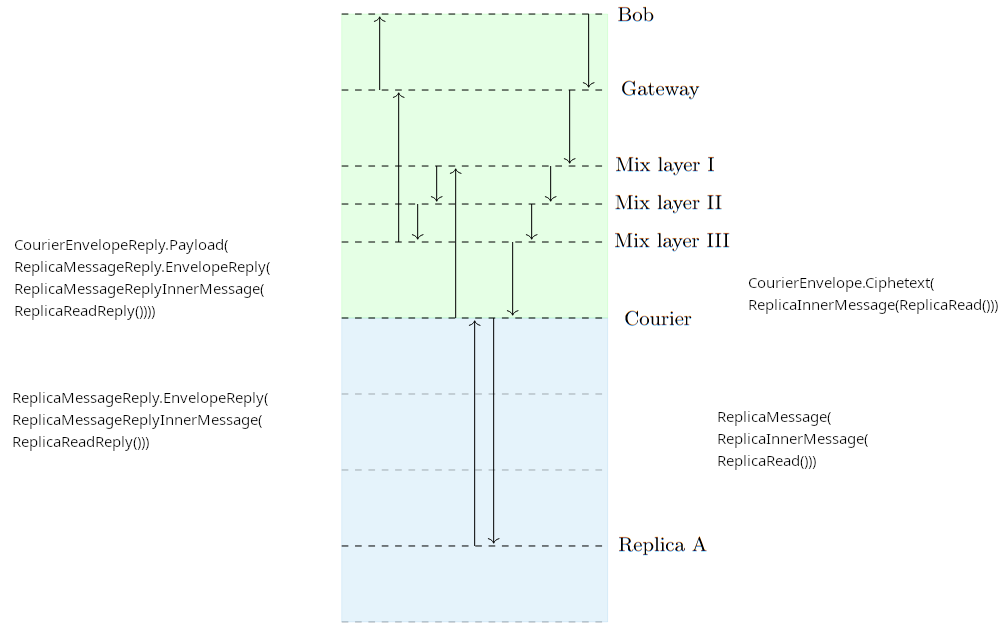
For simplicity, the following diagrams omit replication while illustrating the Pigeonhole write and read operations.
Pigeonhole write operation

Pigeonhole read operation

Pigeonhole AllOrNothing protocol
The All Or Nothing delivery mechanism ensures that a set of
associated BACAP writes either succeeds or fails atomically from the
point of view of a replica or second-party client reader. This
behavior prevents an adversary from detecting a correlation between
(A) the sending client’s failure to transmit multiple messages at once
with (B) a network interruption on the sending client’s side of the
network. Regardless of the number of messages in the set, the
adversary gets to observe “at most once” that the sending client
interacted with the network.
The protocol works as follows.
Step 1
The client uploads a “temporary Pigeonhole stream”.
The stream conveys a sequence of CourierEnvelopes. Each
CourierEnvelope is serialised and prefixed with a single 4-byte
(u32) length field giving the size of that one envelope; the
resulting length-prefixed blobs are concatenated back-to-back into one
continuous byte stream.
That byte stream is then split across the BACAP Boxes of the temporary
stream. A serialised CourierEnvelope is strictly larger than the
maximum BACAP Box payload (it wraps a full Box payload plus its own
metadata), so a single envelope does not fit in one Box and the
concatenated stream necessarily spans several Boxes. Envelope
boundaries therefore do not align with Box boundaries; the precise
framing is given in the “Temporary Stream data format” section below.
Step 2
The client sends a random courier the “Copy” command which
encapsulates the write capability to the temporary Pigeonhole stream written in
Step 1 above. When the courier receives this copy command it extracts
the read cap from the given write cap and uses it to read the stream
of data. The courier then reads a box at a time and tries to extract 0
or 1 envelopes from each accumulation of stream segments.
After processing the command, the courier then overwrites the
temporary stream with tombstones.
Each box in the temporary stream is a serialized CopyStreamElement.
Defined in trunnel as:
// CopyStreamElement - wraps a CourierEnvelope chunk with stream position flags.
// Overhead: 1 byte (flags) + 4 bytes (envelope_len) = 5 bytes
struct copy_stream_element {
// Flags: bit 0 = isStart, bit 1 = isFinal
u8 flags;
// The CourierEnvelope serialized bytes
u32 envelope_len;
u8 envelope_data[envelope_len];
}
Here it is in golang:
type CopyStreamElement struct {
Flags uint8
EnvelopeLen uint32
EnvelopeData []uint8
}
The purpose of this specific format is to use the isStart and isFinal
flags to tell the courier the first box and last box of the stream to
process. The payloads encapsulated within the EnvelopeData fields
of many of these CopyStreamElements is itself a stream of data which
contains 4 byte length prefixed CourierEnvelopes.
A key property of this encoding is that envelope boundaries do not
align with box boundaries. Each BACAP box payload has a maximum size
of N bytes, but a serialized CourierEnvelope (which contains a full
box payload plus metadata) exceeds N bytes. Therefore envelopes are
serialized into a continuous byte stream and split across multiple
boxes in the temporary copy stream:
TEMPORARY COPY STREAM BOXES (each holds N bytes):
βββββββββββββββ βββββββββββββββ βββββββββββββββ βββββββββββββββ βββββββββββββββ
β Box 0 β β Box 1 β β Box 2 β β Box 3 β β Box 4 β
βββββββββββββββ βββββββββββββββ βββββββββββββββ βββββββββββββββ βββββββββββββββ
SERIALIZED ENVELOPE DATA (envelope boundaries don't align with box boundaries):
βββββββββββββββββββββββββββββββββββββββββββββββββββββββββββββββββββββββββββββ
β Envelope 1 ββ Envelope 2 ββ Envelope 3 β
βββββββββββββββββββββββββββββββββββββββββββββββββββββββββββββββββββββββββββββ
| | | | | |
Box 0 Box 1 Box 2 Box 3 Box 4
The courier reads the stream box by box, accumulating data until it
can extract complete envelopes. The isStart and isFinal flags on
the CopyStreamElement wrappers tell the courier where the stream
begins and ends.
Each embedded CourierEnvelope is processed as a normal write and
results in a ReplicaMessage being dispatched to the intermediate
replicas over the wire protocol.
The courier does NOT need to keep track of the EnvelopeHash for each
contained CourierEnvelope for the purpose of replying to the client
(the “client” of these envelopes is, in this case, the courier
itself), but it does need to keep resending them until the
intermediate replicas have ACKed them.
The courier MUST keep track of the hash of the CopyCommand (computed
as BLAKE2b-256(write_cap)) and MUST NOT process a given command more
than once. This dedup cache has a TTL of 30 minutes
(CopyDedupCacheTTL in courier/server/plugin.go).
CopyCommand
Sent by a client to its chosen courier after the client has
successfully uploaded every Box of the temporary stream. The trunnel
layout is:
struct copy_command {
u32 write_cap_len;
u8 write_cap[write_cap_len]; // serialised BACAP BoxOwnerCap
}
On receipt, the courier:
- Computes
copyKey = BLAKE2b-256(write_cap).
- Consults its copy dedup cache. If an in-progress entry is found,
the courier responds immediately with
CopyStatusInProgress. If a
completed entry within its TTL is found, the courier returns the
cached terminal reply.
- Otherwise, the courier reconstructs the BACAP
WriteCap from the
bytes, derives the corresponding ReadCap, and reads the
temporary stream Box by Box, feeding the decrypted BACAP payloads
into a CopyStreamEnvelopeDecoder.
- Each complete
CourierEnvelope emitted by the decoder is
dispatched to its two intermediate replicas; the courier waits for
acknowledgements with bounded retries and exponential backoff.
- Upon processing the Box bearing the
isFinal flag (or upon an
unrecoverable failure), the courier attempts β on a best-effort
basis β to overwrite every Box of the temporary stream with a
tombstone.
Replica error handling during a CopyCommand is classified as
temporary or permanent by
courier/server/copy_errors.go:
transient errors (storage full, database failure, internal error,
replication failed, box-ID not found) trigger bounded retries against
the same shard before failover; permanent errors (invalid box ID,
invalid signature, invalid payload, invalid epoch, box already
exists, tombstone) cause immediate failover or abort.
CopyCommandReply
The courier’s reply to a CopyCommand has the following trunnel
layout:
struct copy_command_reply {
u8 status; // CopyStatus{Succeeded, InProgress, Failed}
u8 error_code; // replica error code (meaningful iff status == Failed)
u64 failed_envelope_index; // 1-based sequential position in the
// CourierEnvelope stream at which processing
// stopped (meaningful iff status == Failed)
}
The status codes are enumerated in “Copy command status codes”
above. failed_envelope_index counts envelopes within the stream,
not boxes: the first envelope in the first box of the temporary stream
is index 1.
A client receiving CopyStatusInProgress should continue polling β
i.e. resend the same CopyCommand via a fresh SURB after a short
interval (CopyPollInterval, currently 5 seconds) β until it receives
either CopyStatusSucceeded or CopyStatusFailed. Because the
courier’s copy dedup cache keys on BLAKE2b-256(write_cap), these
repeated polls will not cause the CopyCommand to be processed more
than once.
Potential use cases of AllOrNothing
In no particular order:
- Atomically writing to two or more boxes.
- The boxes can reside on distinct streams (or not); the courier
doesn’t know anything about streams of
CourierEnvelope.
- Sending long messages that span more than one BACAP payload, like a
file / document / picture.
- Group chat join uses AllOrNothing when adding a new member to the group:
- The person introducing a new member writes to their group chat stream.
- The person introducing a new member also writes to the existing conversation
stream that the new member can already read.
- Group chat uses AllOrNothing in all cases where it needs to send long messages –
files, pictures, audio, long cryptographic keys such as the group
membership list, and so on.
Protocol narration example
Alice wants to send a message to Bob, who is already connected to Alice. That is, Alice will write to a box with ID 12345 that Bob is trying to read from.
-
Alice sends:
1.1. SPHINX packet containing:
-
SPHINX header
- Routing commands to make it arrive at a courier (on a service provider)
-
SPHINX payload
1.2 Alice doesn’t know if the packet makes it through the network. Until she
receives a reply, she keeps resending the CourierEnvelope to the same
courier.
-
The courier receives the CourierEnvelope from Alice.
2.1. The courier records the EnvelopeHash of the CourierEnvelope in
its CourierBookKeeping datastructure.
2.2. If the courier has already seen that hash, GOTO Step 4.
-
The courier sends an ACK to Alice using the SURB on file for Alice, telling her to stop resending the CourierEnvelope. If there’s no SURB, the Courier waits for the next re-sent CourierEnvelope from Alice matching the EnvelopeHash.
3.1. The courier constructs two ReplicaMessage objects and puts them in
its outgoing queue for the two intermediate replicas. (Note that each courier
maintains constant-rate traffic with all replicas).
3.2. The courier keeps doing this for each intermediate replica until it
receives an ACK from that replica.
Aliceβs actions are now complete.
-
The two intermediate replicas receive the two ReplicaMessage objects.
4.1. They decrypt them and compute the “designated replicas” based on
the BACAP box ID.
4.2. The replicas put ACKs in their outgoing queues for the courier saying “we
have received these messagesβ (see step 3.2), referencing the
EnvelopeHash. This tells the courier to stop resending to the intermediate
replicas.
4.3. They put the decrypted contents (a ReplicaWrite BACAP tuple: box ID
12345; signature; encrypted payload) in their outgoing queues for the
“designated replicas”.
4.4. Each replica waits for a reply from its designated replica.
4.5. When an intermediate replica receives its ACK from the designated replica,
the intermediate replica has no more tasks.
Bob now wants to check if Alice has written a message at box 12345
-
Similar to step 1, Bob sends a SPHINX packet to a courier chosen at random.
5.1. SPHINX packet containing:
-
SPHINX header
- Routing commands to make it arrive at a courier (on a service provider).
-
SPHINX payload
-
The envelope tells the courier about two randomly chosen replicas
(βintermediate replicasβ).
-
CourierEnvelope encrypted for a courier chosen at random. Its
encrypted payload is a ReplicaRead command (reference box ID
12345).
5.2. Bob doesn’t know if the packet makes it through the network. Until he
receives a reply, he keeps resending the CourierEnvelope
to the same courier.
-
The courier receives Bob’s CourierEnvelope (see step 2),
-
See step 3.
-
The two intermediate replicas receive the two ReplicaMessage objects containing Bob’s ReplicaRead
8.1. (See 4.1.)
8.2. (See 4.2.)
8.3. (See 4.3.)
8.4. (See 4.4.)
8.5. When the intermediate replica receives its ACK from the designated replica,
it will include the (perhaps confusingly named) ReplicaWrite (BACAP
tuple).
8.6. The intermediate replica wraps it in a ReplicaMessageReply encrypted
for Bob’s ReplicaMessage.EPubKey and puts it in its outgoing queue for the
Courier.
-
The Courier receives two ReplicaMessageReply wire commands from
the two intermediate replicas.
9.1. It matches ReplicaMessageReply.EnvelopeHash to its recorded
bookkeeping state (step 2.1).
9.2. It wraps the replica’s EnvelopeReply blob (the MKEM-encrypted
ReplicaMessageReplyInnerMessage) into a CourierEnvelopeReply
with reply_type = PAYLOAD, and β if Bob’s latest retransmission
arrived with a fresh Sphinx SURB β forwards the resulting
CourierQueryReply back through the mixnet to Bob.
9.3. Either way the courier retains the ReplicaMessageReply in
its dedup cache for the cache TTL (5 minutes), so that a
subsequently-arriving retransmission of the same envelope can be
served from cache without re-dispatching to replicas.
-
Bob keeps resending his CourierEnvelope from step 5 until he
receives a CourierEnvelopeReply with reply_type = PAYLOAD.
10.1. Bob decapsulates the MKEM EnvelopeReply with the private
key corresponding to the sender_pubkey he put in his
CourierEnvelope, obtaining the padded
ReplicaMessageReplyInnerMessage.
10.2. Once unpadded, the inner message is either a
ReplicaReadReply carrying the BACAP tuple (box ID, signature,
ciphertext) or a non-success error_code. If the code is
ReplicaErrorBoxIDNotFound, Bob waits and polls again (i.e.
returns to step 5). If it is ReplicaErrorTombstone, Alice has
deleted the message. Otherwise Bob BACAP-decrypts and verifies
the payload.
10.3. Bob can now read Alice’s message.